Describe How to Select a Sample Using Unequal Probability Sampling
Probability Sampling vs. The chance of getting a sample selected more than once is given by.

The Theory And Logic Of Probability Sampling Nonprobability Sampling Cannot Guarantee A Representative Sample Of The Entire Population Thus All Large Scale Ppt Download
The joint inclusion probabilities of unitkand are defined byπ.
. Sample sample Intersection 500 Replace Proportion. As such non-probability sampling largely depends on a researchers sample selection skills. In this case i miM and our estimator of.
If P is the probability n is the sample size and N is the population. This type of sampling involves random selection methods such as random digit dialing for phone surveys and interviews andor obtaining a list of all possible population elements numbering them and using a random digit table to select your sample participants at random from the list. Unequal-probability sampling that have sampling without replacement using estimators developed by Horvitz and Thompson 1952.
Probability sampling uses random sampling techniques to create a sample. We assume that we are interested in estimating population totals for different subject matter areas and the technique elf rotation sampling is not permitted. Sampling November 2010 30 81.
Gender age range income bracket job role. The selection of the sample mainly depicts the understanding and the inference of the researcher. Suppose that sampling is with replacement the probability of selecting the i th unit in the population is p i.
This type of sampling involves handpicking elements from a sample based on a researchers knowledge and expertise. With some sampling procedures different units in the population have different probabilities of being included in a sample. In a sample with replacement with unequal probabilities p k we can esti-mate N without bias using the Hansen-Hurwitz estimator.
The inclusion probability refers to the probability that. The chance of getting a sample selected only once is given by. For a sample to qualify as a probability sample each person in a population must have an equal chance of being selected for a study and the researcher must know the probability that an individual will be selected.
P i i 1 2 3 N. Therefore you decide to use a stratified sample relying on a list provided by the university of all its graduates within the last ten years. Using the probability sampling method the bias in the sample derived from a population is negligible to non-existent.
In statistics sampling is when researchers determine a representative segment of a larger population that is then used to conduct a study. P 1-1-1N n. Sampling comes in two forms probability sampling and non-probability sampling.
The balancing equations in 11 can also be written as ∠k∈U a k s k ∠k∈U a k pi k with s k ∈ 0 1k∈U Sampling with Unequal Probabilities 53 where a. Letnsdenote the size of the samples. N 1 n n α 1 1 p k α where α is the sample number k α is the identifier of the individual selected for drawing number α and n is the size of the sample.
On each draw the probability that a given population unit will be selected is denoted as. The Hansen-Hurwitz estimator for sampling with replacement that is. Sampling With Unequal Probabilities Ppt Download.
The differing inclusion probabilities may result from some inherent feature of the sampling procedure or they may be imposed deliberately to obtain better estimates by including more important units with higher probability. In cluster sampling it is often use-ful to use unequal-probability sampling with replacement with probabilities proportional to size PPS. In other words this method is based on non-random selection criteria.
There are two types of non-probability sampling methods. When the sample size is not random we denote the sample size byn. Probability sampling is the most common form of sampling for public opinion studies election polling and other studies in which results will be applied to a.
P 1 N-1NN-2N-1N-nN-n-1 Cancelling 1-N-nn P nN. An unequal probability sampling design is often characterized by its first-order inclusion probabilities given byπ. Like other methods of probability sampling you should begin by clearly defining the population from which your sample will be taken.
If I were to utilize this method in my research proposal I. In non-probability sampling also known as non-random sampling not all members of the population have a chance to participate in the study. The benefit of using probability sampling is that it guarantees the sample that should be the representative of the population.
The bias introduced when k is not an integer is inconsequential with large populations. PPS sampling with replacement. The fourth argument enables you to specify the unequal sampling probabilities as follows.
3 For k 2N do 1 Compute qksk PrSk skjSk 1 sk 1S1 s1 P s2QjSkskSk 1sk 1S1s1 ps P s2QjSk 1sk 1S1s1 pssk 012. In summary when you want to sample with replacement and with unequal. Thus selecting a sample consists in choosing a vertex a sample of the N-cube that is balanced.
2 Select the kth unit sk times according to the distribution qkk. If the selection probabilities are unequal the sample mean is not unbiased for population mean and sample total is not unbiased for population total. Tortora 7 based on probability proportional to size PPS sampling using burden as an inverse measure of size.
Define your population and subgroups. This is contrary to probability sampling where each member of the population has a known non-zero chance. The third argument to the SAMPLE function enables you to specify whether the sampling is done with or without replacement.
Probability sampling leads to higher quality data collection as the sample appropriately represents the. It is important to point out that in this sampling. RSSs produce unbiased samples when k is an integer.
Based on the overall proportions of the population you calculate how many people should be sampled from each subgroup. In the absence of periodicity and with a known population size to determine a sampling interval k divide the size of the population N by a desired sample size n. Yves Till e Uneq.
We compare the proposed PPS sampling scheme with the current method. The selection probability is the probability that element i is selected at one draw selection step. 2 Select the rst unit s1 times according to the distribution q1s1.
The notation for selection probability is written as P_i or p_i. Probability Sampling methods are further classified into different types such as simple random sampling systematic sampling stratified sampling and clustered sampling. When the selection probabilities do not change after every draw bases on this probability.
To use this sampling method you divide the population into subgroups called strata based on the relevant characteristic eg.
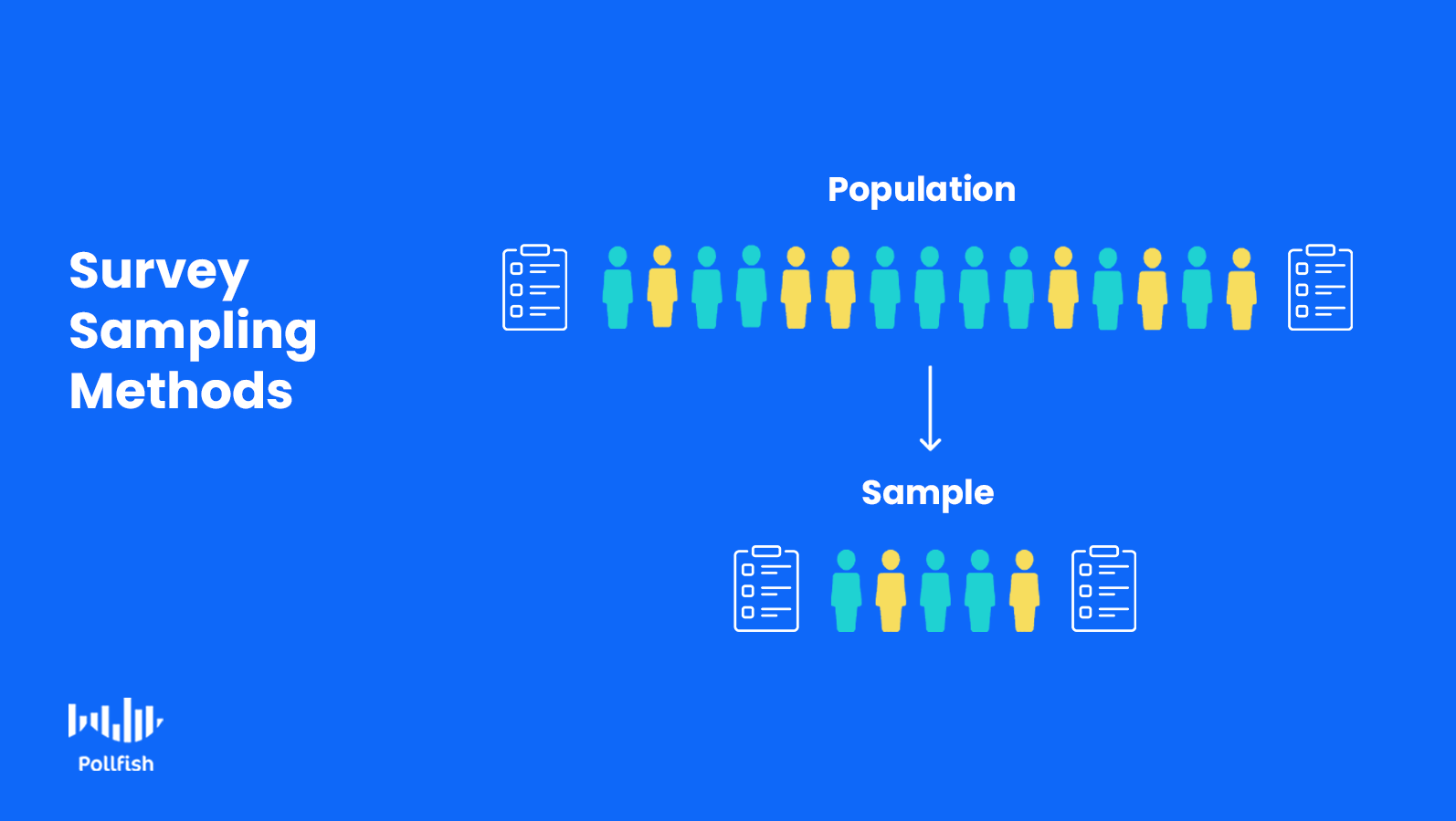
Mastering Survey Sampling Methods For Consumer Intelligence Pollfish Resources
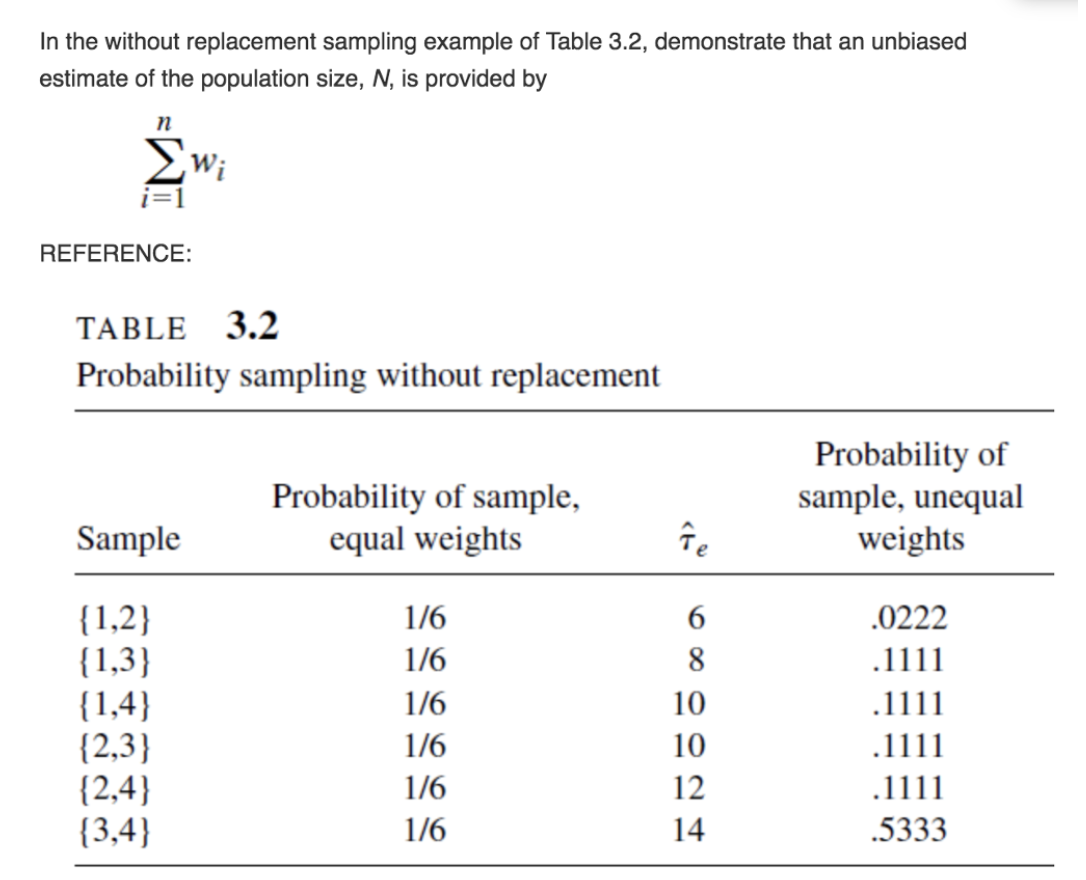
Solved In The Without Replacement Sampling Example Of Table Chegg Com

Mastering Survey Sampling Methods For Consumer Intelligence Pollfish Resources

Mastering Survey Sampling Methods For Consumer Intelligence Pollfish Resources
0 Response to "Describe How to Select a Sample Using Unequal Probability Sampling"
Post a Comment